Monday, November 27, 2017

Practicum - Week 4

Dates:  Monday, September 18th

Monday, September 18th


After much thought, I decided that a FAFSA workshop for teens would be a great way to guide students and parents on filling out the application, especially since it opens on October 1st for the 2018-2019 school year.  I proposed this to the Teen Department supervisor, April, who thought it was a great idea.  I also called the local college's Student Financial Services Department to see what help, if any, they could provide.  I was pleasantly surprised to learn they offer free outreach events such as FAFSA drives to help people of the community with filling out the application and providing information sessions on the types of financial aid assistance available (grants, loans, etc.).  I spoke with the Financial Aid Specialist to determine availability of their staff  and determine two tentative dates for the Fall semester:  October 24th and November 15th.

I had to complete a program proposal for approval from both the Teen Department Supervisor and the Library Director.  In the proposal, I had to create a description of the program and how it would help meet the library's mission and goals.  I also had to create an action plan which provided a detailed strategy on steps needed to ensure the program's goals would be met; the materials and resources needed for the program to take place; and how the effectiveness of the workshop would be assessed.
Once I completed the program proposal, I submitted it to the Teen Department Supervisor for approval.


Weekly reflection:  I am very excited that local college personnel who specialize in providing financial aid assistance and are knowledgeable of the types of aid available will be conducting these workshops for the people of the community.  Since I work at the local college, I am aware of some of the challenges and obstacles students face in funding their college education.  I have heard many students say they get frustrated while filling out the FAFSA because it is too long and too confusing to complete.  Many often give up and wait until the last minute to file an application because they are pushed to do so.  I am hoping high school students preparing to graduate will take advantage of the information available at these workshops so that they can complete the FAFSA early and correctly.

Also, I am surprised to learn that the local college offers FAFSA workshops, College Information Nights, and FAFSA drives to high schools and community organizations in the area for free.  I was unaware that this was even available and it makes me wonder what other free services the local college offers to the surrounding community.

Practicum - Week 3

Date: Friday, September 15 (2 hours)

Friday, September 15th


I was officially assigned to the Teen Department and met with the Teen Services Supervisor, April.  We sat down and talked about the needs and interests of the department for future programming and project proposals.  April told me she would like to see more programming that involves career preparation for teens, college visits, and financial aid assistance.  She also identified that the Teen Department's nonfiction collection needed attention by identifying which titles need to be weeded and what new additions would help to strengthen it.

Weekly reflection:  I'm excited to be working in the library's Teen Department.  Much of my coursework has focused on children and young adult literature so it will be exciting to see how I can apply what I've learned to an actual library setting.  I'm really interested in assisting with programs that can help teens prepare for college since I currently work at a local community college.  I think my 10 years of experience working in a college environment will help me generate ideas for programs the McAllen Library's Teen Department can implement.

Friday, October 27, 2017

Practicum - Week 2

Dates:  Friday, September 8th

No hours completed on Monday, the 4th due to the library being closed in observance of Columbus Day.

Friday, September 8th

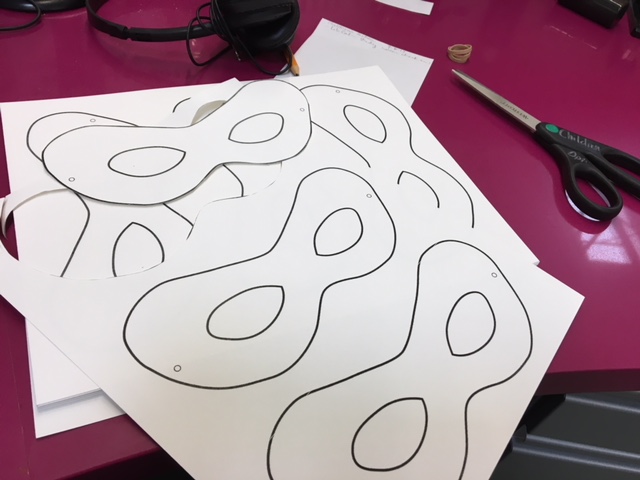
I covered in the Children's Department again today because it was short staffed.  Today's focus was on cutting out over 250 hero masks for the upcoming South Texas Comic Con Fan Weekend Event, scheduled for September 10th.  The McAllen Public Library will have a children's booth at the event to give away the masks as well as provide information about the services the library offers.  I ran off the copies on tag board paper, and used scissors and a utility knife to cut out the masks.   This took most of the day!


Weekly reflection:  Although I went in one day this week, it was very busy.  The short-staffing problem seems be something all areas of the library are struggling with.  Many of the departments "borrow" or pull personnel from other areas to make sure their areas are staffed adequately.  As a future library employee, I think it will be critical to have knowledge of all areas and services contained within the library so that if called upon, I can provide the assistance and support needed within the department.

I enjoyed making the hero masks for the upcoming Comic Con event.  It was a fun stress relief from the everyday, busy tasks of the adult world.  

Practicum - Week 1

Practicum Site:  McAllen Public Library Main Branch, McAllen, Texas


Dates: Monday, August 28th and Friday, September 1

Monday, August 28th

I was assigned to the Children's Department this week since the Teen Department supervisor is out on vacation.  After finalizing my paperwork with the administration secretary, I shadowed one of the children's librarians, Heather.  She gave me a tour of the children's sections, showing me where the grade level, graphic novel, and new book arrivals were located. I also learned the children's department created a new "Parent Help" section filled with books that parents could check out for help on topics such as autism, helping children navigate elementary school, and helping children cope with separation and divorce.  Having these parent resources available in the children's section allows the parent to peruse the helpful titles while staying in the same area their younger children may be using.

Since it was the first week of school for most local school districts, the library was quiet.  I shadowed Heather as she helped several children find books on requested subjects such as Minecraft, Captain Underpants, and "a book about twins who are always fighting with each other."  I am realizing the importance of staying current with children's interests since many of the books the children were looking for were unfamiliar to me.  If a book was unavailable, the children's librarian, Heather, was able to suggest several other book titles  similar to the requested title so the child still had something to read.  As a future librarian, it would be helpful to know additional book titles so children have more options when selecting a book.


Friday, September 1st

Today was my first full day at the McAllen Library so I was given a full tour of all the departments and areas of the library.  I was shown how to use the LS2 Staff system so that I could check out books to patrons, create new library cards, and clear library fines.  I was also shown how books are returned through the library's conveyor belt, and how books are processed and reshelved upon their return. I shadowed the welcome and information desk personnel to learn more about customer service.


I also shadowed in the library's computer lab where patrons are able to access computers, wifi, printers, and fax machines.  I was pleasantly surprised to see that the library owns several 3D printers and allows for patrons to use it for their own projects.  I was shown how the 3D printer works, how to set up the extractors for use, and how to access the program files needed to  construct a 3D print. I was thrilled to create a 3D print of a cat!


Since it was Hispanic Heritage Month as well as Library Card Sign-Up Month, I set up the children's department's book display.  I was surprised that the department's book display is in the middle of the collection and the book covers face away from incoming traffic.  Young children would not be able to see these special-themed books unless they ventured towards the middle of the room (of which many do not).  I would think that having the book display at the entrance of the department with the title's facing outwards towards patrons would better entice young children to pick up and preview the book.


After I set up the book display, I took the previous month's display books and changed their collection status in the LS2 system (New Arrival books changed back to Juvenile/Childrens).  Once completed, I helped cut out the Teen Titans Display figures that had been painted the day before for display in the children's section.  During closing time (approximately 20 minutes before doors close), I helped clean up the children's area, pushed in seats, powered down computers, and disinfected toys with the help of the Children's Department Assistant, Erin.


First week reflections:  After my first week, I am excited that I will be completing my practicum at the McAllen Public Library.  I was able to meet most of the full time staff who were very helpful in explaining what they do, how things run, and how they help provide the best service to patrons.  It was great seeing them work independently within their own departments as well as part of a larger team.  I am looking forward to what the next few weeks will bring.


Thursday, December 4, 2014

In Our Mothers' House by Patricia Polacco


BIBLIOGRAPHY

Polacco, Patricia.  2009. IN OUR MOTHERS' HOUSE.  New York: The Penguin Group.  ISBN 9780399250767

PLOT SUMMARY

IN OUR MOTHERS' HOUSE is a story told by an African-American girl (her name is never given) who is adopted as an infant by two women, known affectionately as Marmee and Meema.  The family is made complete with the addition of her adopted brother, Will (of Asian-American decent) and adopted sister, Millie (Caucasian decent).  Set in Berkeley, California, the young narrators tells of the family's everyday life experiences,  lively holiday celebrations, and neighborhood gatherings.  However, one neighbor, Mrs. Lockner  doesn't want her children to associate with this multicultural family.  The children learn that families can look different, but the most common thread in all of them should be love and acceptance.

CRITICAL ANALYSIS

This book chronicles the story of two women choosing to build a family and raise them in a household full of love.  The women's homosexuality is not the focus of this story; instead, the message that prevails is one of familial love and support.  As children turn the pages of this book, they see this blended family participating in everyday activities other families take part in: sitting by the fireplace telling stories, trick-or-treating around the neighborhood streets, and playing in the backyard tree house.   The pencil-sketch and watercolor illustrations depict the family's happiness and love.  The characters are seen happily playing and running carefree.  Young readers receive the message that nontraditional families can be just as loving and caring as traditional families.  This point is driven home when the narrator states "There wasn't a day in my life that I didn't feel deeply loved and wanted by Meema and Marmee.  Our mothers were willing to do anything for us.  We knew that."

Although most people in the neighborhood are supportive of the family, one woman is not:  Mrs. Lockner.  The author describes how the Lockner kids are invited to play in the tree house, but their parents quickly take them away: "They barely spoke to us... They just plain didn't like us, I guessed.  I couldn't quite understand why.  We always tried to be respectful and friendly, the way our mothers taught us to be."   Mrs. Lockner's disapproval of the women's lifestyle and family comes to a head at the neighborhood party when she angrily confronts and screams at the two women, "I don't appreciate  what you two are!"  Having witnessed this tense exchange, Millie asks her mother why Mrs. Lockner lashed out at them.  Meema explains to her children "She's full of fear, sweetie.  She's afraid of what she cannot understand: she doesn't understand us."  Marmee adds that "there seems to be no love in her heart, either."  Thus, young audience members begin to realize that not everyone is acceptable or comfortable seeing blended families in which parents are of the same-sex.   The mothers' explanations to their children expose a hard truth; one that many are not willing to admit to.

While this book presents a loving story about a lesbian couple raising a blended family, it feels as if the author tried too hard to present a perfect story.  On nearly every page, all of the characters are smiling from ear to ear.  Even the neighborhood dogs and cats are smiling!  While the message the author wants to get across to young readers is that nontraditional families can be just as loving as others, the illustrations feel like overkill in presenting readers how happy life can be.   Another concern I had with this story is how the author seems to sweep the incident between Meema and Marmee and Mrs. Lockner under the rug.  No mention is made about how the family handles the tense confrontation or how the children were affected.  It seems that life goes on for them.  I think it would have been much more meaningful if the author had build in a conversation the two mothers have with their children, describing to them that there may be people who do not understand their family, but it doesn't change the fact that they are still loved and cared for.  

Finally, one of the drawbacks of the story is found in the illustrations that seem to confirm the stereotype of lesbians and lesbian couples.  The women are drawn as brawny and masculine looking, with short cropped hair and wearing men's clothing.  This is further emphasized when the narrator describes how the mothers begin to prepare for a mother-daughter tea party they will host in their home. After she tells her mothers they will need to wear long dresses for the special occasion, she notes "Meema and Marmee looked at each other and shrugged.  We had never seen either of them in a dress... ever!"  Young readers may interpret these illustrations to mean that lesbians always have short hair and do not dress in a feminine way.  I fear that these pictures will solidify the stereotypical beliefs other may have instead of breaking down those barriers.

REVIEWS

THE BULLETIN OF THE CENTER FOR CHILDREN'S BOOKS: "Polacco's distinctive pencil and marker illustrations abound with strong, warm-toned colors, softened by the pencil linework, and smiling faces; facial expressions are at once goofy and joyful, and the multitudes of loose-limbed characters create a general sense of ebullience and cheer. Unfortunately, the lack of coherent storyline and overdose of sweetness make the narrative an uneven and text-heavy stroll down a very selective memory lane. The didacticism is only heightened when the family is confronted by an evil neighbor (identifiable by her grumpy expression, the only such face in the book) who doesn't accept them, whereupon the narrator immediately asserts that "there wasn't a day in my life I didn't feel deeply loved and wanted by Meema and Marmee."

KIRKUS:  "Unfortunately, while this ambitious picture book seeks to offer an inclusive vision of family, it ultimately comes up short. Meema and Marmee's eldest daughter offers a sweeping narrative about three children embraced by their loving, interracial, adoptive family and multicultural community, with their "mothers' house" at the center of it all. It is outside of this safe haven that the children face overt and neatly contained homophobia in the character of one bad apple, who declares, "I don't appreciate what you two are!" The distillation of hate into a single character undermines the reality of systematic oppression faced by same-sex couples... There is a desperate need for books that present queer families as just another part of the American quilt, but this title, despite its obvious good intentions, doesn't do it."

CONNECTIONS

* Have students read similar stories detailing families with same-sex parents:

Garden, Nancy.  2004.  MOLLY'S FAMILY.  ISBN  9780374350024
Newman, Leslea.  2011.  DONOVAN'S BIG DAY.  ISBN  9781582463322
Oelschlager, Vanita. 2010.  A TALE OF TWO DADDIES.  ISBN 9780981971452
Oelschlager, Vanita.  2010.  A TALE OF TWO MOMMIES.  ISBN  9780982636664
Setterington, Ken.  2004.  MOM AND MUM ARE GETTING MARRIED.  ISBN 9781896764849

Wednesday, December 3, 2014

The Running Dream by Wendelin Van Draanen


BIBLIOGRAPHY

Van Draanen, Wendelin.  2011. THE RUNNING DREAM.  New York: Random House Children's Books.  ISBN 9780375866678

PLOT SUMMARY

Sixteen-year-old Jessica Carlisle lives to run.  As one of her high school's track stars, Jessica is expected to beat out her top rivals and possibly earn a running scholarship to go to college.  However, a devastating school bus accident ends her dreams, and she wakes up finding part of her right leg amputated. THE RUNNING DREAM chronicles Jessica's physical and emotional journeys as she is introduced to a new way of life and a new way of thinking about others.

CRITICAL ANALYSIS

In her novel, THE RUNNING DREAM, Wendelin Van Draanen brings a powerful and moving story to expose young readers to the realities and challenges individuals with disabilities face.  Although fictional, readers are drawn into the story by the accurate details the author consistently uses throughout its pages.  Since Jessica is a partial leg amputee, Van Draanen includes details of numerous visits to Dr. Wells, her orthotics doctor who fits her with a prosthesis.  Through these visits, readers learn that most leg amputees are fitted with a temporary limb while constant measurements and adjustments are made to ensure a comfortable and accurate fit for a final limb.  Readers also learn that the first step in this process is taking a plaster cast of the affected limb.  This is evident in a passage describing Jessica's first visit to Dr. Wells: "He has me take off my shrinker sock.  Then he starts measuring. He uses tools like I've seen my dad use. A metal caliper. A tape measure. Something that looks like a carpenter's square.  He takes all sorts of measurements of my stump side, and of my good side."   Accurate details are also included in creating the socket for the artificial limb and the various types of socks needed to cushion the contact site: "Right on top of the stocking, he begins marking places.  Around my knee.  Along what's left of my shin...The pencil he's using is blue, and when he's done, the stocking looks like a little kid scribbled on it."  Inclusion of these intricate details reveal that the author has done careful research on the process amputees must go through when being fitted for a prosthesis.  

Jessica's confrontation and acceptance of her disability is the strength of this book.  Van Draanen does an exquisite job in providing readers with a first-hand account of the feelings and thoughts someone endures when they must confront their disability.  Jessica's journey from bleak hopelessness to strength and hope is skillfully woven throughout the text.  Jessica's struggles to accept her new life without a limb are evident in the comments and thoughts she shares with the audience.  She says things such as "My life is over... I wipe away my tears and nod, because the pain in my leg is nothing compared to the one in my heart."  When others try to encourage her and tell her things will get better, she tells the audience "They talk some more, but I stop listening.  What does it matter how long it takes?  I'll never recover.  I can't see how I'll ever even adjust."  However, as Jessica overcomes challenges such as showering by herself, climbing her home's stairs, and patiently waiting for her residual limb to arrive, she encounters individuals who are just like her, living as amputees and leading normal lives.  Her attitude begins to change and she begins to be grateful for what she does still have: "I rub my hands together, spreading out the soap, and as I massage both sides of my head, I'm thankful for my hands.  Thankful to have both of them."  As she begins to socialize with her friends again, their words of support and encouragement pull her out of the darkness.  This is evident when Jessica reflects "I wipe my eyes with the napkin, and somewhere inside me I can feel a shift.  I'm turning a corner...It feels so, so good."   

By the end of the story, Jessica has come full circle and had learned life can still go on, and her disability cannot limit her hopes and dreams.  As the last few pages of the book draw to a close, readers are left feeling just as happy and fulfilled as Jessica.  She comments "One by one by one.  That's how I got through losing my leg.  Minute by minute by minute.  Hour by hour by hour.  Day by day by day.  That's how anybody makes it through anything."  However, the most powerful sentiments are found in the book's closing lines detailing Jessica's growth: "Eight months ago it was a herculean effort to walk myself and my IV stand to the bathroom.  Today I ran my friend ten miles across her first finish line.  Eight months ago I couldn't do anything.  This race made me believe that there's nothing I can't do."  Readers are left in awe as they witness Jessica's phenomenal transformation, and are reminded, that although challenges may come, one must take it day by day to come out of the trial stronger and better.

This 2012 Schneider Family Book Award winner also confronts the many of the challenges individuals with disabilities face when dealing with others.  When Jessica finally returns to school after the horrific accident, she notices the stares and averted eyes from her fellow classmates.  She fears that people will only see her disability now and not her.  These thoughts make reader reflect on their own attitudes and behaviors around those that are disabled.  Although difficult, Jessica knows that some people do not know what to say or do, and whether they should even mention the "elephant in the room."  Jessica realizes her own ignorance and prejudices when she is told to sit next to Rosa, a fellow classmate in Jessica's math class that has cerebral palsy.  She describes "For a moment my mind's blank.  Then I realize she means the special-needs girl who sits at the classroom.  The girl in the motorized wheelchair.  The girl who rarely talks and when she does, is very hard to understand.  I didn't even know her name was Rosa."  As Jessica and Rosa forge a beautiful bond of friendship, Jessica realizes that Rosa also has dreams she would like to fulfill, but given her condition, may never be able to do.  Jessica makes it a mission to fulfill Rosa's dream of knowing what it feels like to run.  As she trains to take Rosa on a ten mile run, she emphasizes to those in her community "That's all anybody with a disability wants.  Don't sum up the person based on what you see, or what you don't understand; get to know them" and see them for who they are.   Again, young readers will begin to think about their own perceptions they may have towards those who have disabilities, perhaps making them change how they speak and treat these special individuals.

REVIEWS

BOOKLIST: "Van Draanen's extensive research into both running and amputees pays dividends readers will truly feel what it's like to walk (or run) a mile (or 10) in Jessica's shoes."

CHILDREN'S LITERATURE: "The story is touching without being maudlin. Although Jessica's story has a "happy ending," it also comes with the reality of what it costs--physically, emotionally and financially--to come back from such a devastating physical trauma."

KIRKUS: "the pace of Van Draanen's prose matches Jessica's at her swiftest. Readers will zoom through the book just as Jessica blazes around the track. A lively and lovely story."

CONNECTIONS

Have students watch and listen a short video of the author, Wendelin Van Draanen, describing her inspiration for writing THE RUNNING DREAM.  This may be found at https://www.youtube.com/watch?v=bAV5ActuNUU

Share similar books or books that have a similar theme:

Jordan Sonnenblick.  AFTER EVER AFTER.  ISBN 054572287X
Helen Frost.  HIDDEN.  ISBN 0374382212
Lauren Baratz-Logsted.  CRAZY BEAUTIFUL.  ISBN 0547403100

Saturday, November 29, 2014

Ask Me No Questions by Marina Budhos


BIBLIOGRAPHY

Budhos, Marina.  2006. ASK ME NO QUESTIONS.  New York: Antheneum Books for Young Readers.  ISBN 9781416903512

PLOT SUMMARY

Years after immigrating from Bangladesh to the United States, Nadira and her family find themselves seeking asylum in Canada after their visas have expired; they had been living illegally in the United States for several years.  However, after being denied admittance into the Canadian country, Nadira's life falls to pieces when she sees her father arrested and taken into custody.  ASK ME NO QUESTIONS documents Nadira and her family's experience while they await for her father's fate at his immigration hearing.

CRITICAL ANALYSIS

This powerful novel allows young readers a glimpse of the immigrant experience living in America.  Set in New York City, ASK ME NO QUESTIONS chronicles the events and  feelings of fourteen year old, Nadira, whose family has migrated from Bangladesh and has made life for themselves in the United States.  Nadira describes herself as being chubby and ordinary, eating Sugar Babies and SweeTarts, and enjoying contemporary artists such as Britney Spears.  Her sister, Aisha, is known as the smart one,  always saying the right thing, and is in the running to be chosen as the school valedictorian.  Her mother is limited in her English-speaking ability, but is relaxed in observing  Muslim traditions such as fasting for Ramadan or praying the required five times day.  Nadira's father, known as Abba, is described as being grateful for the opportunity the United States provides for the family: "Abba loves this country in his own way; it's like this bowl he carries in his hear- so full, so ready to trust." 

Life seems ordinary for the family until the events of September 11th, in which society begins to view her and her Muslim community as outsiders.  She describes an incident in which bullying and harassment occurs: "a man who had one side of his face bashed in, and another who was run off the road in his taxi and called bad names."  Nadira also describes a time her older sister, Aisha, comes home crying because of the school kids make fun of her hijab head scarf; and how "some Pakistani kids walking down Northern Boulevard" were called "dirty Arabs" because of the way she looked.  In a powerful statement, Aisha tells the audience, "Overnight, we, the invisible people, became visible.  We became dangerous.  We became terrorists, people with bombs in our luggage, poison in our homes."  Nadira echoes these thoughts as she says "We watched the news of the war and saw ourselves as others saw us: dark, flitting shadows, grenades blooming in our fists.  Dangerous."  These honest revelations about the harassment and prejudice experienced within the Muslim community impacts all readers as they begin to develop an understanding of those whose life experience is different from their own. 

Nadira also describes how law enforcement and the enactment of laws by the federal government post 9/11 have impacted the Muslim community.  In a significant statement, Nadira describes to young readers, "We began to feel as if the air had frozen around us, trapping us between two jagged ice floes.  Each bit of news was like a pieces of hail flung at us, stinging our skin."  This is noticeably evident when people within the Muslim community begin to suddenly disappear without any notice.  Nadira and her family soon discover that many individuals have been detained for questioning, and have often been deported to Bangladesh.  The fear of her own family disappearing is brought to light when Nadira's sister, Aisha, confides in her, her own fear of being arrested and sent back to Bangladesh.  She describes a frightening nightmare in which "policemen come and tell me, 'You don't belong here.' Then they take me and lock me up in a cell with no light."  

Her family's fears are worsened when Nadira's own father is arrested and detained for having an expired visa while in the United States.  Young readers truly see how this immigration issue effects children when Nadira and Aisha describe their worries and fears over their father's detainment: "Aisha is finally saying what we're both afraid to imagine: Abba crouched in a cold dark cell. Abba sitting at some table with a ceiling lamp glaring down on his face.  Are they badgering him with questions?  Letting him sleep and bathe and pray?  Beating him with a stick until the bruises show like flowers?"  These very real worries bring to light the fears that many immigrant children may have when their own families are in jeopardy of being deported.  The stable and calm life they once had is now gone and fear and worry have taken its place instead.

Mixed into this story are cultural markers of the Muslim and Bengali community which add credibility to Budhos' novel.  The names are authentic (Aisha, Nadira, Taslima, Tareq) as are the details included about the Muslim culture (praying five times a day, fasting for Ramadan, and discussing the Koran).  As an added touch, Budhos weaves into the text authentic Bengali words and phrases to ensure readers are fully immersed in Nadira's world.

This powerful and moving story sheds light on the immigrant experience many share in the United States.  For some readers, they may see themselves reflected in this story while others may begin to finally understand and empathize with those whose life experiences are different from their own.  This compelling story will cause readers to reflect on their own attitudes and prejudices and instill in them a hope that things can be different.

REVIEWS

CHILDREN'S LITERATURE: "Inspiring and timely, this novel explores one of the most difficult issues facing the United States today in a compelling and highly readable way."

KLIATT REVIEW: "This is a powerful story, especially for those YAs who know something themselves about the immigration situation. Budhos doesn't make heroes of the illegal immigrants, but she illuminates the reasons why families stay here, and she focuses on the children who have grown up in America but who are threatened with deportation because of the mistakes of their parents."

THE BULLETIN OF THE CENTER FOR CHILDREN'S BOOKS: "Budhos has composed a compelling and thought-provoking contemporary examination of the human side of the law; further, in illustrating the secret burden that Nadira and Aisha carry with them to school each day as they pretend that nothing is the matter, she reminds readers to think differently about the people around them. Sure to elicit discussion, this novel would work very well for a teen book club selection."

CONNECTIONS

Have students listen to an interview the author, Marina Budhos, gives detailing how she brought this book to life.  This can be found at http://ia902302.us.archive.org/12/items/InterviewWithAuthorMarinaBudhos/Marina_Budhos_If_Youre_Just_Joining_Us.mp3

Hold a discussion with your class addressing immigration issues students hear in the news.  You can use reflective questions found in a reading guide located at http://iss.schoolwires.com/cms/lib4/NC01000579/Centricity/Domain/632/lg_amnq%20reading%20guide_0020.pdf